|
Investigating Planets
Here are some digital resources you may use with this Unit of the Investigating Astronomy Curriculum.
Exploration One: Important Planatery Characteristics
Activity 1: Group the Planets and Moons
Optional:
Check out a planet sorting game at Windows to the Universe.
Activity 3: Size, Mass, and Gravitational Force
Activity 4: Debating Planetary Atmospheres and Temperatures
US Environmental Protection Agency: Climate Change
PBS NOVA/Frontline Interviews: The Debate
PBS NOW: Debating �Global Warming�
Wikipedia: Global Warming
Wikipedia: Global Warming Controversy
NASA�s Earth Observatory: Global Warming
NASA Goddard: Global Change Master Directory
Exploration Two: Distances to and Among the Planets
Activity 3: Kepler�s Laws
Kepler�s Laws I, II, and III
Exploration Three: Explorations of the Planets and Their Moons
Activity 2: Mission Particulars
Exploration Four: Search for Life in Our Solar System
Activity 3: Water and Habitability
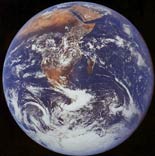
NASA: Visible Earth
Earth Observatory
NSSDC Photo Gallery: Earth
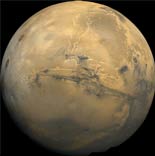
NSSDC Photo Gallery: Mars
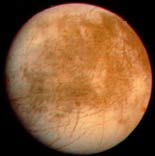
NSSDC Photo Gallery: Europa
JPL Photojournal
Marsquest: Rover Images
Exploration Five: Extrasolar Planets
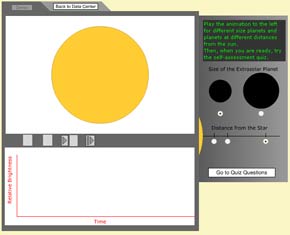
Activity 2: Transiting Method of Finding Extrasolar Planets
Activity 3: Search the Web for Recent Discoveries
List of Extrasolar Planets
Planet Quest: New Worlds Atlas
Doing Science
Extending Your Work
Recommended Resources
Astronomical Society of the Pacific (ASP)�the largest general astronomy society in the world
Astronomy Magazine�a monthly magazine for amateur astronomers
Sky and Telescope�a monthly magazine providing articles and information on all aspects of astronomy, space exploration, telescope equipment, and amateur telescopes
Jet Propulsion Laboratory�builds and operates many of the unmanned spacecraft responsible for exploring our solar system
NASA: Astrobiology�NASA's Website for information on searching for life in the universe
Binocular Stargazing by Mike D. Reynolds (Stackpole Books, 2005, ISBN:0811731367)�an easy-to-use guidebook for observing the sky with binoculars
The Planets by Dava Sobel (Viking Adul, 2005, ISBN-13:978-0670034468)�a book of essays on the latest scientific knowledge about the planets, blended with popular culture, mythology, astrology, literature, music, and more
|